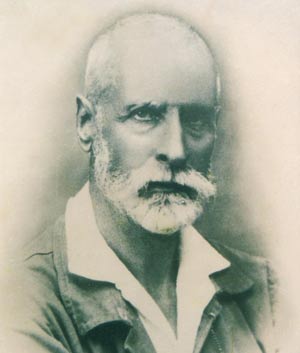
Alexandre Emile Jean Yersin (September 22, 1863–March 1, 1943) was a Swiss and French physician and
bacteriologist. Along with
Shibasaburo Kitasato, he is remembered as the co-discoverer of the bacillus responsible for the bubonic plague or pest, which was later re-named in his honor (
Yersinia pestis).
Yersin was born in 1863 in Aubonne, Canton of Vaud, Switzerland, to a family originally from France. From 1883 to 1884, Yersin studied medicine at Lausanne, Switzerland; and then at Marburg, Germany and Paris (1884–1886). In 1886, he entered Louis Pasteur's research laboratory at the École Normale Supérieure, by invitation of Emile Roux, and participated in the development of the anti-rabies serum. In 1888 he received his doctorate with a dissertation entitled Étude sur le Développement du Tubercule Expérimental and spent two months with Robert Koch in Germany. He joined the recently-created Pasteur Institute in 1889 as Roux's collaborator, and discovered with him the diphtheric toxin (produced by the Corynebacterium diphtheriae bacillus).
In order to practice medicine in France, Yersin applied for and obtained French nationality in 1888. Soon afterward (1890), he left for French Indochina in Southeast Asia as a physician for the Messageries Maritimes company, on the Saigon-Manila line and then on the Saigon-Haiphong line. He participated in one of the Auguste Pavie missions. In 1894 Yersin was sent by request of the French government and the Pasteur Institute to Hong-Kong, to investigate the Manchurian Pneumonic Plague epidemic, and there, in a small hut next to the institute ( according to "Plague" by Wendy Orent) along with his co-discoverer Shibasaburo Kitasato, he made his greatest discovery, that of the pathogen which causes the disease. He was also able to demonstrate for the first time that the same bacillus was present in the rodent as well as in the human disease, thus underlining the possible means of transmission. This important discovery was communicated to the French Academy of Sciences in the same year, by his colleague Emile Duclaux, in a classic paper titled La Peste Bubonique A Hong-Kong (Ann. Inst. Pasteur. 8: 662-667).

From 1895 to 1897, Yersin further pursued his studies on the bubonic plague. In 1895 he returned to the Institute Pasteur in Paris and with Émile Roux, Albert Calmette and Amédée Borrel, prepared the first anti-plague serum. In the same year, he returned to Indochina, where he installed a small laboratory at Nha Trang, in order to manufacture the serum (in 1905 this laboratory was to become a branch of the Pasteur Institute). Yersin tried the serum received from Paris in Canton and Amoy, in 1896, and in Bombay, India, in 1897, with disappointing results. Having decided to stay in his country of adoption, he participated actively in the creation of the Medical School of Ha Noi in 1902, and was its first director, until 1904.
Yersin also tried his hand at agriculture, and was a pioneer in the cultivation of rubber trees (Hevea brasiliensis) imported from Brazil into Indochina. For this purpose, he obtained in 1897 a concession from the government to establish an agricultural station at Suoi Dau. He also opened a new station at Hon Ba in 1915, where he tried to acclimatize in that country the quinine tree (Cinchona ledgeriana), which was imported from the Andes in South America by the Spaniards, and which produced the first known effective remedy for preventing and treating malaria (a disease which prevails in Southeast Asia to this day).
Alexandre Yersin is well remembered in Vietnam, where he was affectionately called Ông Năm (Mr. Nam/Fifth) by the people. Following the country's independence, streets named in his honor kept their designation, and his tomb in Suoi Dau was graced by a pagoda where rites are performed in his worship. Yersin's house in Nha Trang is now the Yersin Museum, and the epitaph on his tombstone describes him as a "Benefactor and humanist, venerated by the Vietnamese people". At Ha Noi, a French Lycée has his name. A private university founded in 2004 in Da Lat was named "Yersin University" in his honour.
In 1934 he was nominated honorary director of Pasteur Institute and a member of its Board of Administration. He died during World War II at his home in Nha Trang, in 1943.
Dr. Yersin was credited for finding the site for the town of Dalat (300 km North West of Saigon) in 1893. Because of the high altitude and European-like climate, Dalat soon became an R&R spot for the French officers. There was a high school named after him which was built in the 1920s i.e. Lycee Yersin aka Grand Lycee (grade 6 to 12) vs Petit Lycee (elementary to grade 5) and a university named for him which was built in the 2000s.
While in Hong Kong, Yersin was helped in his search by an Italian priest of PIME order. He provided dead bodies and assisted him in his quest for a remedy for the plague. The name of this priest was Bernardo Vigano' (1837–1901).

 Dalat Native